Research Use Only: All NEXALUME LABS products are intended and labeled solely for laboratory research use. They are not intended, manufactured, tested, or released for human or veterinary administration.
This article provides general scientific information regarding standard laboratory in vitro and in vivo research contexts only, and does not constitute a validated experimental protocol, medical guidance, clinical guidance, veterinary guidance, or treatment advice.
A Cerebrolysin-type material is not a single peptide with one fixed sequence. It is a porcine brain protein hydrolysate that contains many low-molecular-weight peptide fragments and free amino acids.[1][2]
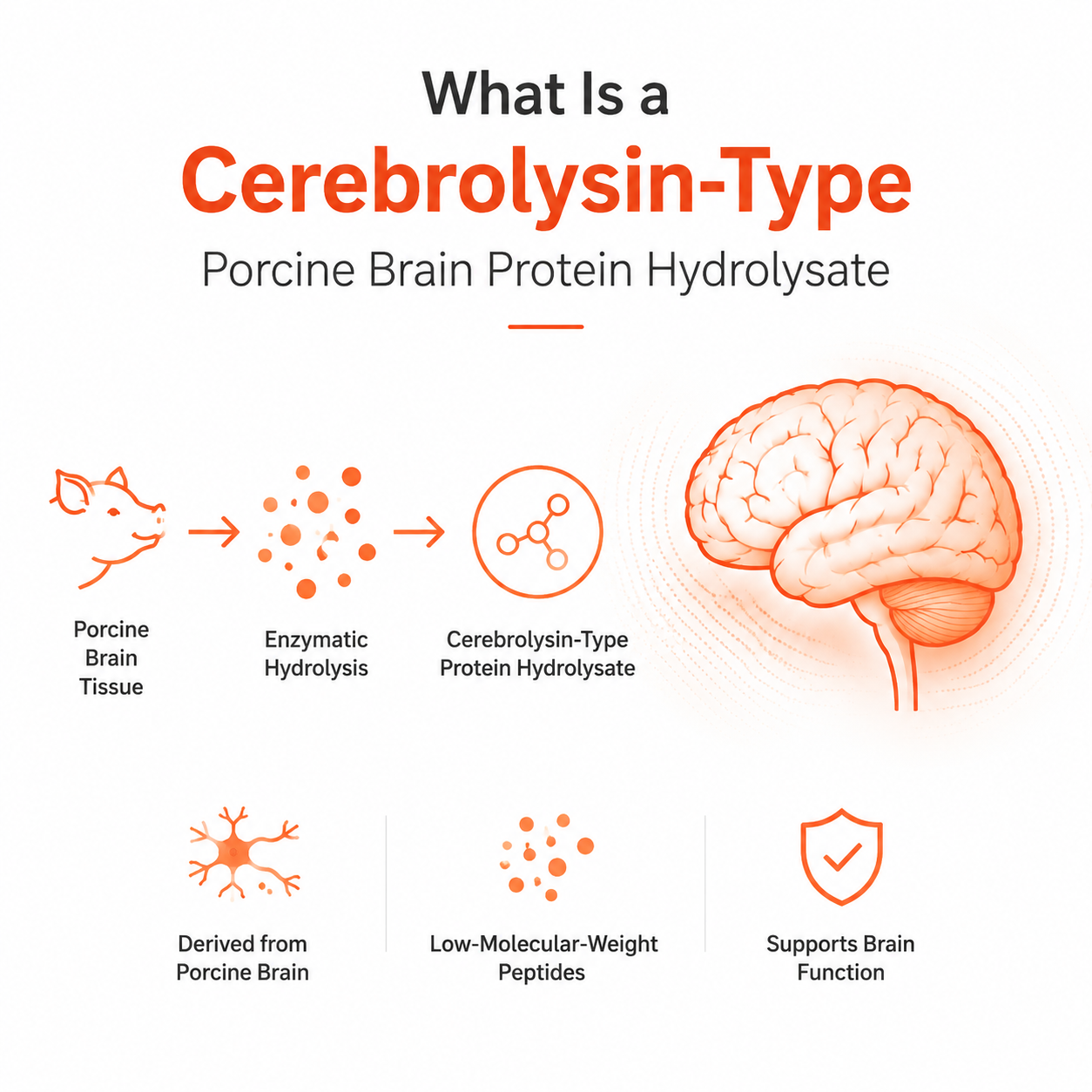
Cerebrolysin® is a registered trademark and a specific parenteral product.
Unless a third-party laboratory sample has been demonstrated through comparative peptide profiling, molecular-weight distribution, total solids, free amino acid content, chromatographic fingerprinting, and bioactivity testing to be equivalent to the reference product, it should not be assumed to be interchangeable. This article discusses published scientific literature on this type of material; the specific research material supplied by NEXALUME LABS is a laboratory product and is not the registered pharmaceutical preparation.[1]
Because it is a mixture, there is no single molecular formula, molecular weight, or amino acid sequence for the whole material.
Results should therefore be reported as information about a specific sample or batch, not as properties of one defined molecule.
What Is in the Mixture
Gevaert et al. (2015) used HPLC coupled to ion trap mass spectrometry and UHPLC coupled to quadrupole-ion mobility-time-of-flight mass spectrometry (Q-IM-TOF MS), combined with a UniProt pig protein database search and PEAKS de novo sequencing, to analyze one sample of Cerebrolysin obtained online. They identified 638 unique peptide sequences.
The main components originated from porcine tubulin alpha- and beta-chains, actin, and myelin basic protein. The study did not find peptide fragments from the known neurotrophic factors glial cell-derived neurotrophic factor (GDNF), nerve growth factor (NGF), brain-derived neurotrophic factor (BDNF), or ciliary neurotrophic factor (CNTF).[1]
The number 638 is not a fixed product specification but reflects one analysis of one sample. A later study reported 14,635 sequences in a selected light-peptide fraction, while a 2023 study showed that peptide identification changed substantially with sample preparation and sequence-analysis software.[3][4]
These two counts of 638 and 14,635 were generated using materially different samples, fractionation procedures, and data-analysis workflows. They should not be interpreted as directly comparable measures of product richness, concentration, or batch quality; the reported peptide list depends on the sample, the instrument, the database or de novo approach, the search parameters, the false discovery rate threshold, and whether modified peptides or homologous matches are counted.
| Feature | Single Synthetic Peptide | Cerebrolysin-Type Hydrolysate |
|---|---|---|
| Sequence | One known sequence | Many peptide fragments; no single defined sequence |
| Formula and molecular weight | One defined value | No single value for the whole mixture |
| HPLC result | Can support purity or assay of a defined analyte when the method is validated | Used as a chromatographic fingerprint or profile; a global “purity” claim is generally not interpretable |
| Mass spectrometry | Checks the expected intact molecular ion; MS/MS supports sequence confirmation | Detects many ions and assigns candidate sequences against a defined database with stated search parameters and FDR |
How to Read HPLC and Mass-Spectrometry Results
For a complex mixture, HPLC can compare the overall profile of different batches. A global claim such as “HPLC purity ≥98%” is generally not scientifically interpretable for the entire heterogeneous hydrolysate unless a defined analyte, detection wavelength, integration rule, calculation basis, and validated acceptance criterion are specified.
For a mixture containing many peptides with different UV response factors at 214/220 nm, co-eluting peaks, and non-UV-absorbing components, area-normalized purity cannot be equated to mass percentage. More appropriate approaches include chromatographic fingerprinting with batch-to-batch similarity criteria, specified molecular-weight-range proportions, characteristic marker peptide content, total solids or total nitrogen, and free-to-peptide-bound amino acid ratios.
LC-MS and LC-MS/MS can help identify peptide signals, but the final list depends on sample preparation, the instrument, the database or software, the search parameters, and the rules used to accept a sequence. Intact-mass matching alone does not confirm chromatographic purity, stereochemical identity, counterion content, concentration, or biological activity.
Analytical methods should be suitable for their stated purpose; the fit-for-purpose principles described in ICH Q2(R2) may be applied by analogy when developing or qualifying analytical procedures for this research material, but the guideline’s formal regulatory scope depends on the product classification and intended use.[5]
What Preclinical Studies Have Reported
- In cultured embryonic chick cortical neurons, one study reported fewer apoptosis-related cell changes under its test conditions.[2] In brain-tissue culture models exposed to glutamate or oxygen-glucose deprivation, another study reported differences in neuronal-survival measurements after the preparation was added to the culture medium.[6]
- A separate paper reported lower microglial-activation measurements in cell and laboratory-animal models.[7]
- In a rat middle cerebral artery occlusion model, researchers reported changes in neurogenesis markers and behavioral test results. The authors of this study included individuals affiliated with EVER Neuro Pharma, the manufacturer of Cerebrolysin®.Industry affiliation does not invalidate the findings, but it increases the importance of independent replication, pre-registered protocols, and transparent reporting.[8] In an APP-transgenic mouse model, another study reported changes in hippocampal neurogenesis-related measurements.[9]
These preclinical findings cannot by themselves establish efficacy, safety, dose-response relationships, or clinical benefit in humans. They do not identify one active peptide, prove direct binding to a specific receptor, or show effects in humans.
The main active components and their direct molecular targets have not been fully confirmed.[1][4]
Animal studies should clearly report sample size, randomization, blinding, inclusion and exclusion rules, animal details, procedures, outcome measures, and statistical methods. These are core points in the ARRIVE 2.0 reporting guidelines.[10]
What a Useful COA Should Show
A Certificate of Analysis for this type of mixture should identify the exact batch and explain what each result means. For a porcine brain-derived peptide hydrolysate, a product-specific specification should be established according to the intended research use rather than adopting a single-peptide purity model.
Useful information may include:
- Batch details: Product name, supplier, lot number, physical form, and stated concentration basis (e.g., total solids, total nitrogen, total amino acids, or peptide-equivalent content).
- HPLC or UHPLC fingerprint: Test method, detector wavelength, sample conditions, representative chromatogram, and the rule used to compare or accept the profile (e.g., similarity score or acceptance range for characteristic peaks).
- Mass spectrometry profile: Instrument type, sample preparation, software or database, search parameters, sequence-acceptance rules, and false discovery rate threshold.
- Molecular-weight distribution: The proportion of material within specified molecular-weight ranges, rather than a single average value.
- Free vs. peptide-bound amino acid ratio: Distinguishing free amino acids from peptide-bound residues, which affects the interpretation of biological activity.
- Source material and processing: Tissue origin, species traceability, processing steps, and controls for exogenous agents and cross-contamination.
- Process-related residuals: Residual enzymes, solvents, metals, or other processing-related materials, where relevant.
- Other tests: Water or moisture for dry material, residual solvents when relevant, pH, osmolality, and microbiological or endotoxin testing when required by the laboratory model. Limits should be selected according to the cell or animal model and route of experimental exposure; no single universal value applies to all RUO products.
- Storage and stability: Storage conditions supported by actual product-specific stability data under the proposed conditions, including long-term, accelerated, opened-container, and freeze-thaw stability using stability-indicating fingerprint or functional methods where available. General stability principles, including the need for product-specific data, may be referenced by analogy; the applicable regulatory guideline depends on the product classification.[12]
BCA, Bradford, and UV-based protein assays can produce method-dependent apparent concentrations in heterogeneous peptide hydrolysates. BCA responds to peptide bonds and certain amino acid side chains and is susceptible to interference from reducing agents and chelators; Bradford is sensitive to protein length and basic/aromatic residue composition, with weak responses to short peptides; UV absorbance at 280 nm depends heavily on tryptophan, tyrosine, and disulfide content, while A205/A214 responds primarily to peptide bonds but may be affected by buffer salts and other organic components.
Results should be reported with the assay chemistry, calibration standard, wavelength, sample matrix, and validation or recovery data. These tests should not be described as direct measurements of “active peptide concentration” unless the method has been validated for that specific mixture.[11]
A batch meeting its stated COA specification confirms only that the tested lot met the supplier’s release criteria.
It does not prove human-use safety, clinical effectiveness, or veterinary suitability.
Storage and Laboratory Use
Storage instructions should come from the product label and product-specific stability data. A general rule used for a lyophilized single peptide, such as automatic storage at −20°C, should not be applied to a complex liquid mixture without supporting data.
General stability principles requiring product-specific, stability-indicating data under proposed storage conditions may be referenced by analogy; the applicable regulatory guideline depends on the product classification.[12]
For cell-based work, researchers should record the stock concentration basis, final test concentration, dilution factor, total volume, and vehicle control. They should also check whether salts, preservatives, or pH-adjusting agents in the supplied material could affect the assay.
All preparation and dilution information is for qualified laboratory research only. It must not be used as a human or veterinary administration guide.
Research Use Only Disclaimer
Research Use Only: All NEXALUME LABS products are intended and labeled solely for laboratory research use. They are not intended, manufactured, tested, or released for human or veterinary administration.
Unless comparative analytical and bioactivity data have demonstrated equivalence, third-party laboratory materials should not be assumed to be interchangeable with any registered pharmaceutical product. This article provides general scientific information regarding standard laboratory in vitro and in vivo research contexts only, and does not constitute a validated experimental protocol, medical guidance, clinical guidance, veterinary guidance, or treatment advice.