RESEARCH USE ONLY: This article is for qualified laboratory researchers only. It is not a home-use guide.
The information below must not be used for human consumption, human administration, veterinary use, injection, dosing, diagnosis, treatment, cosmetic use, or personal experimentation. Any new animal work must be conducted under applicable institutional approval.
The animal research cited here refers to published laboratory animal studies.
Vasoactive intestinal peptide (VIP) is a naturally occurring peptide made of 28 amino acids. Sami Said and Viktor Mutt first isolated it from porcine small intestine in 1970.[1]
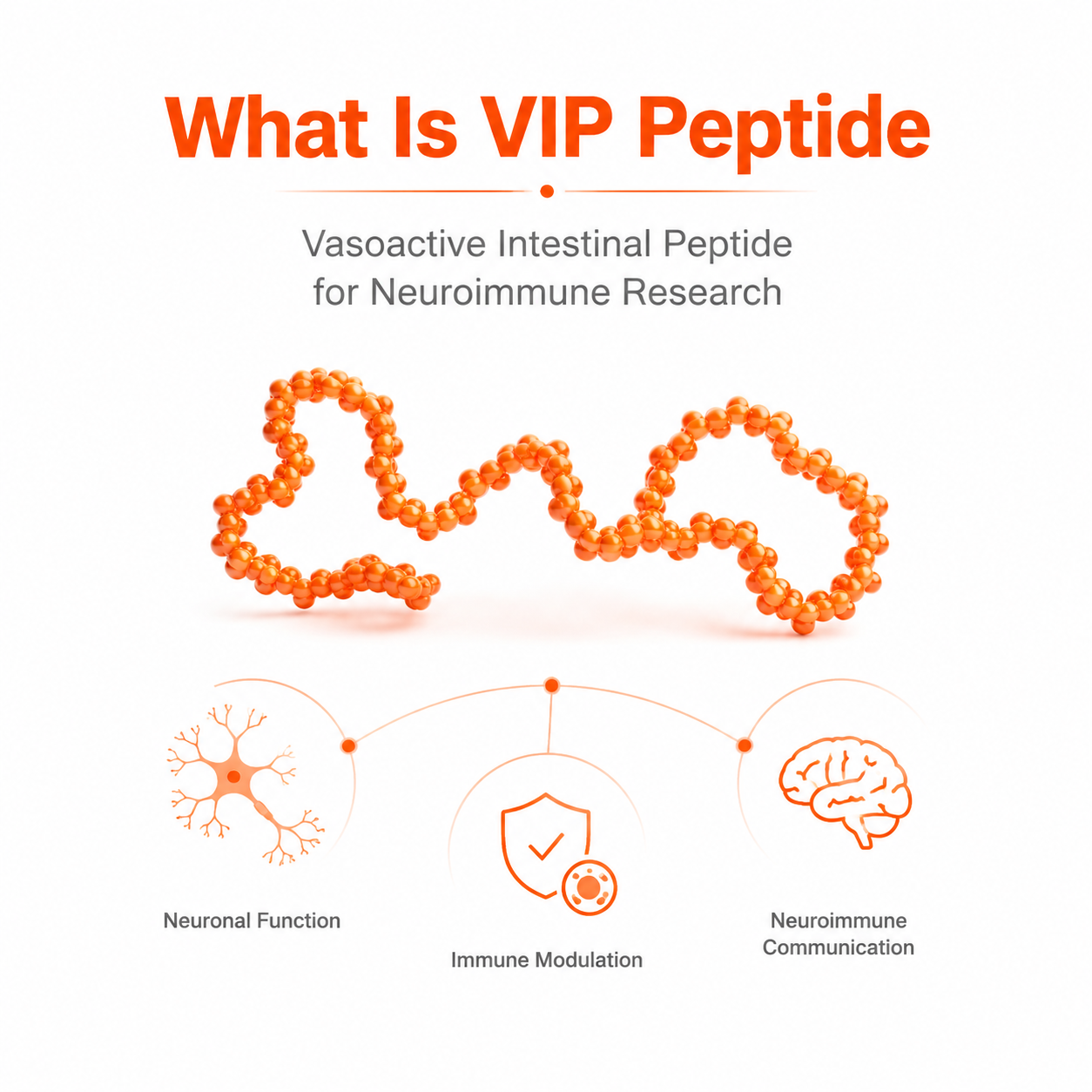
Researchers study VIP in receptor assays, cell cultures, isolated tissues, brain slices, and published laboratory animal models. Results can change with the species, cell type, test method, peptide concentration, and exposure time.
A result from one model should not be treated as proof of safety or effectiveness in people or animals.
What VIP Is
The mature human VIP peptide has 28 amino acids and an amidated C terminus. It is generated by proteolytic processing of the canonical 170-amino-acid human prepro-VIP precursor (UniProt P01282).
Alternative human transcript and protein isoforms have also been annotated.[2]
H-His-Ser-Asp-Ala-Val-Phe-Thr-Asp-Asn-Tyr-Thr-Arg-Leu-Arg-Lys-Gln-Met-Ala-Val-Lys-Lys-Tyr-Leu-Asn-Ser-Ile-Leu-Asn-NH2
HSDAVFTDNYTRLRKQMAVKKYLNSILN-NH2
| Item | Reference value |
|---|---|
| Length | 28 amino acids |
| C terminus | Amidated (Asn-NH2) |
| Molecular formula | C147H238N44O42S (neutral amidated peptide moiety; counterions and water excluded) |
| Average molecular weight | Approximately 3,325.8 g/mol |
| Monoisotopic mass | 3,323.7561 Da[3] |
| Human gene location | Chromosome 6q25.2 |
PubChem CID 16140438 lists the amidated VIP structure, sequence, molecular formula, average molecular weight, and monoisotopic mass shown above.[3] The human VIP gene is located at chromosome 6q25.2.[4]
The sequence, terminal group, formula, and molecular weight must describe the same chemical form. A free-acid form, TFA salt, acetate salt, labeled peptide, or oxidized peptide may have different data.
The average molecular weight of 3,325.8 g/mol should not be used as the direct high-resolution mass spectrometry (HRMS) target. Mass-spectrometric results should specify whether the reported value is an observed m/z, a charge-state assignment, a deconvoluted mass, an average molecular mass, or a monoisotopic mass.
These values should not be compared interchangeably.
For that reason, the product label and batch COA should be checked before any calculation or experiment.
How VIP Receptors Work
VIP mainly binds two receptors called VPAC1 and VPAC2. PAC1 is a related receptor, but it normally responds much more strongly to PACAP than to VIP—in most PAC1 isoforms, PACAP is typically over 100-fold more potent than VIP.[5]
In many cell-based tests, VPAC1 and VPAC2 activate the Gs protein, increase adenylyl cyclase activity, and raise the level of cAMP inside the cell. The later response depends on the type of cell and the test conditions.[6]
Binding values and activity values can vary between laboratories. Kd, Ki, IC50, and EC50 measure different things and should not be used as if they were the same number.
The 2012 IUPHAR review by Harmar et al. provides a comprehensive reference for these parameters across receptor subtypes and species.[6]
Immune-Cell Research
VIP has been studied in macrophages, monocytes, T cells, and other immune-cell models. Reviews of this work show that the result depends on the cell type, stimulus, receptor level, species, concentration, and exposure time.[7]
Delgado et al. (1999) found that VIP and PACAP reduced TNF-α production in LPS-stimulated mouse macrophage cultures. The same paper also reported reduced TNF-α in a laboratory mouse endotoxin model.[8]
A separate macrophage study by the same group reported lower inducible nitric oxide synthase (iNOS) expression and reduced NF-κB and IRF-1 activation after VIP or PACAP exposure. The study used mouse peritoneal macrophages, the RAW 264.7 mouse macrophage cell line, and a laboratory mouse endotoxemia model.[9]
These studies describe results from defined laboratory models. They do not show that a research peptide is safe or effective for human or veterinary use.
Brain and Circadian Research
VIP is also studied in the suprachiasmatic nucleus (SCN), the brain area that helps organize daily rhythms. Aton et al. (2005) found that VIP-deficient mice showed weaker synchronization between clock cells and disrupted daily rhythms in SCN tissue.
The genetic model used in these studies is also described as a VIP/PHI-deficient model because disruption of the precursor locus affects both VIP and peptide histidine isoleucine (PHI). Rescue experiments using VPAC2 agonism nevertheless support a specific role for VIP–VPAC2 signaling.[10]
Brown et al. (2007) found disrupted firing rhythms in suprachiasmatic nucleus neurons of VIP/PHI-deficient mice.[11] These findings are limited to the tested mouse and tissue models and should not be presented as a consumer sleep claim.
Smooth-Muscle and Digestive Research
Cell, tissue, and laboratory animal studies have examined VIP in intestinal secretion, smooth-muscle relaxation, blood-vessel responses, and movement of the digestive tract. The mechanism is not identical in every tissue or species, so these findings should be reported with the exact model and test conditions.[12]
Laboratory Storage and Solution Preparation
LABORATORY WARNING: The information in this section is only for in-vitro sample preparation by qualified laboratory staff. It is not an injection, administration, or dosing guide.
- Follow the batch documents. Use the storage temperature and light-protection instructions printed on the product label and COA.Do not replace batch-specific instructions with a general storage rule.
- Confirm the peptide form. Check the sequence, C-terminal modification, salt or counterion, molecular weight, and net peptide content before calculating a molar concentration.
- Use an assay-compatible solvent. Choose a solvent supported by the product documentation or a qualified preparation procedure. Do not assume that one solvent works at every concentration or pH.For example, VIP free peptide and VIP TFA salt may require different solvent systems; published methods have used water, dilute acetic acid, or other buffers depending on the product form and assay.
- Use net peptide content when required. Gross vial mass may include water, counterions, and other non-peptide material. It may not equal the amount of active peptide.
- Keep records. Record the lot number, solvent, concentration, pH, preparation date, storage condition, and number of freeze-thaw cycles.
How to Read a COA
A certificate of analysis is a batch-specific quality record. It should identify the lot, chemical form, test methods, and reported results.
- HPLC or UPLC purity: The area percentage shows the relative size of detected chromatographic peaks under that method. It does not by itself prove identity, net peptide content, sterility, endotoxin level, or biological activity.
- Mass spectrometry: MS can support identity by checking the measured mass. A matching mass does not by itself prove chromatographic purity.The COA should specify whether the reported mass refers to an average molecular mass (3,325.8 g/mol), a monoisotopic neutral mass (3,323.7561 Da), an observed m/z with charge state, or a deconvoluted mass.
- Water, counterions, and residual solvents: These are separate quality items. They should not be estimated from the HPLC purity result.
- Method suitability: ICH Q2(R2) is a pharmaceutical analytical-validation framework. Its fit-for-purpose principles—including selectivity, accuracy, precision, range, and robustness—may be used as scientific reference benchmarks for research-use-only peptides, although Q2(R2) is not an automatically mandatory requirement for every RUO supplier or product.[13]
- Residual-solvent testing: When residual solvents are relevant to the manufacturing process, they are normally checked with a suitable validated method, often gas chromatography.ICH Q3C(R9) provides the main solvent classification framework for pharmaceutical drug substances and products; its scientific principles may be used as reference benchmarks but it is not automatically mandatory for every RUO supplier.[14]
A batch meeting its stated COA specification indicates that the batch conforms to the supplier’s tested release criteria. It does not by itself establish suitability for a particular assay, biological model, or research objective.
The COA does not prove safety, clinical effectiveness, or approval for human, veterinary, cosmetic, or diagnostic use.
Research References
- Said SI, Mutt V. Polypeptide with broad biological activity: isolation from small intestine. Science. 1970;169(3951):1217-1218. doi:10.1126/science.169.3951.1217. PubMed 5450698.
- UniProt Consortium. VIP proprotein — Homo sapiens, UniProtKB P01282. UniProt P01282.
- National Center for Biotechnology Information. PubChem Compound Summary: VIP (Human, Porcine), CID 16140438. PubChem CID 16140438.
- National Center for Biotechnology Information. VIP vasoactive intestinal peptide, Gene ID 7432. NCBI Gene 7432.
- IUPHAR/BPS Guide to Pharmacology. VIP and PACAP receptors. VIP and PACAP receptor family.
- Harmar AJ, Fahrenkrug J, Gozes I, Laburthe M, May V, Pisegna JR, Vaudry D, Vaudry H, Waschek JA, Said SI. Pharmacology and functions of receptors for vasoactive intestinal peptide and pituitary adenylate cyclase-activating polypeptide: IUPHAR Review 1. British Journal of Pharmacology. 2012;166(1):4-17. doi:10.1111/j.1476-5381.2012.01871.x. PubMed 22289055.
- Delgado M, Ganea D. Vasoactive intestinal peptide: a neuropeptide with pleiotropic immune functions. Amino Acids. 2013;45(1):25-39. doi:10.1007/s00726-011-1184-8. PubMed 22139413.
- Delgado M, Pozo D, Martinez C, Leceta J, Calvo JR, Ganea D, Gomariz RP. Vasoactive intestinal peptide and pituitary adenylate cyclase-activating polypeptide inhibit endotoxin-induced TNF-alpha production by macrophages: in vitro and in vivo studies. Journal of Immunology. 1999;162(4):2358-2367. PubMed 9973516.
- Delgado M, Munoz-Elias EJ, Gomariz RP, Ganea D. Vasoactive intestinal peptide and pituitary adenylate cyclase-activating polypeptide prevent inducible nitric oxide synthase transcription in macrophages by inhibiting NF-kappa B and IFN regulatory factor 1 activation. Journal of Immunology. 1999;162(8):4685-4696. PubMed 10202009.
- Aton SJ, Colwell CS, Harmar AJ, Waschek J, Herzog ED. Vasoactive intestinal polypeptide mediates circadian rhythmicity and synchrony in mammalian clock neurons. Nature Neuroscience. 2005;8(4):476-483. doi:10.1038/nn1419. PubMed 15750589.
- Brown TM, Colwell CS, Waschek JA, Piggins HD. Disrupted neuronal activity rhythms in the suprachiasmatic nuclei of vasoactive intestinal polypeptide-deficient mice. Journal of Neurophysiology. 2007;97(3):2553-2558. doi:10.1152/jn.01206.2006. PubMed 17151217.
- Iwasaki M, Akiba Y, Kaunitz JD. Recent advances in vasoactive intestinal peptide physiology and pathophysiology: focus on the gastrointestinal system. F1000Research. 2019;8:F1000 Faculty Rev-1629. doi:10.12688/f1000research.18039.1. PubMed 31559013.
- International Council for Harmonisation. ICH Q2(R2): Validation of Analytical Procedures. ICH Q2(R2).
- International Council for Harmonisation. ICH Q3C(R9): Impurities — Guideline for Residual Solvents. ICH Q3C(R9).
Research Use Only Disclaimer
Research Use Only: Products offered on saiyanmed.com are intended solely for qualified laboratory research. They are not intended for human consumption, human or veterinary administration, clinical or veterinary diagnosis or treatment, cosmetic use, household use, or personal experimentation.
Product-specific labels, COAs, and safety documents take precedence over general website content. This article provides general scientific information regarding standard laboratory research contexts only, and does not constitute medical, clinical, veterinary guidance, or treatment advice.