Research Use Only — Laboratory Personnel Only: This article is for qualified laboratory researchers. It covers in-vitro assays and laboratory animal studies conducted under institutionally approved animal-use protocols only.
It does not provide instructions for personal use, home preparation, human use, veterinary treatment, or cosmetic use. Any liquid handling mentioned below refers only to laboratory sampling and pipetting.
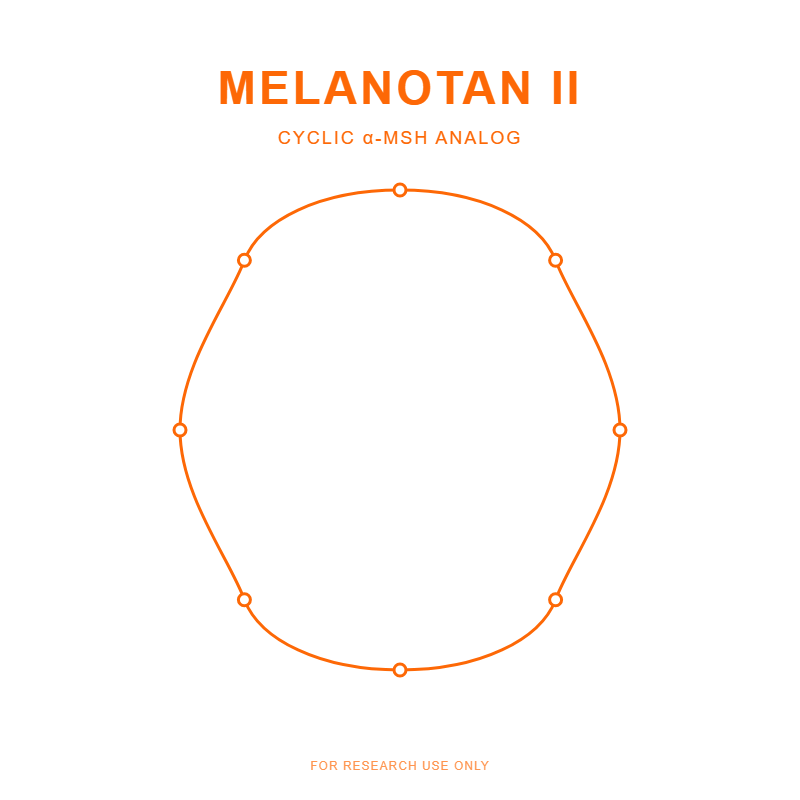
Melanotan II, often shortened to MT-II, is a synthetic cyclic peptide used in melanocortin receptor research. It is based on part of the alpha-melanocyte-stimulating hormone (alpha-MSH) sequence.
In laboratory studies, MT-II activates MC1R, MC3R, MC4R, and MC5R, so it should be treated as a broad agonist rather than a receptor-selective tool.[1][2]
Basic Information
| Item | Information |
|---|---|
| Common name | Melanotan II; MT-II |
| CAS number | 121062-08-6 |
| Counterion-free peptide formula | C50H69N15O9 |
| Average molecular weight (counterion-free peptide) | Approximately 1,024.2 g/mol |
| Monoisotopic mass (counterion-free peptide) | 1,023.5403 Da[1] |
| Sequence | Ac-Nle-cyclo[Asp-His-D-Phe-Arg-Trp-Lys]-NH2 |
| Length | Seven amino-acid residues |
| Main structural feature | A side-chain lactam bond between Asp and Lys, forming a 23-membered ring |
The formula and molecular weight above describe the counterion-free peptide. The average molecular weight of 1,024.2 g/mol should not be used as the direct high-resolution mass spectrometry (HRMS) target.
The expected MS m/z depends on the ionization method, charge state, adducts, and whether average or monoisotopic mass is reported; the neutral monoisotopic mass is 1,023.5403 Da, and the theoretical [M+H]+ ion is approximately 1,024.5475 m/z. A supplied batch may also contain acetate, trifluoroacetate, water, or other non-peptide material.
For accurate molar calculations, use the peptide-content and counterion information on the batch Certificate of Analysis (COA), not the vial weight alone.[1][3]
How the Structure Is Built
MT-II contains a short receptor-binding region related to the His-Phe-Arg-Trp sequence found in melanocortin peptides. Its D-Phe residue changes the shape of this region, while the Asp and Lys side chains are joined by an amide bond to form a ring.
This is a side-chain-to-side-chain ring, not a bond between the peptide’s two ends. Structure-function studies on this cyclic heptapeptide MT-II, a lactam derivative of alpha-melanotropin, directly describe the Asp–Lys side-chain lactam as the defining structural feature.[2][4]
The N-terminus is acetylated and the C-terminus is amidated. These changes, together with the ring, affect the peptide’s shape, receptor activity, and resistance to some forms of enzymatic breakdown.
Small changes to the sequence or ring can also change which melanocortin receptors a related peptide activates.[2]
Receptor Activity
The melanocortin family has five receptors: MC1R, MC2R, MC3R, MC4R, and MC5R. MT-II is commonly used as an agonist at MC1R, MC3R, MC4R, and MC5R.
MC2R differs from the other melanocortin receptors because ACTH is its cognate agonist and functional receptor surface expression generally requires the melanocortin-2 receptor accessory protein (MRAP). MT-II should not be used as an MC2R agonist reference.[5][6]
| Receptor | Simple research interpretation |
|---|---|
| MC1R | MT-II can activate MC1R in receptor or pigment-cell assays. |
| MC2R | Do not use MT-II as an MC2R agonist reference. MC2R generally requires MRAP for functional cell-surface expression. |
| MC3R | MT-II can be used as a broad agonist in MC3R expression systems. |
| MC4R | MT-II can activate MC4R, but it is not MC4R-selective. |
| MC5R | MT-II can activate MC5R in receptor-expression assays. |
A common laboratory readout is an increase in intracellular cAMP. However, potency values can change with the receptor species, cell line, receptor expression level, exposure time, and assay format.
Studies using MC4R have shown that cAMP signaling kinetics can vary with the agonist and measurement time point, so results from one test system should not be copied directly into another system without confirmation.[7]
Reading the COA
A COA gives quality information for one batch. It does not show that the material is suitable for human, veterinary, cosmetic, diagnostic, or clinical use.
| COA item | What it tells you |
|---|---|
| HPLC purity | The percentage of detected chromatographic area assigned to the main peak under the stated method. HPLC purity and peptide content are different measurements; the target peptide’s absolute amount generally requires both values to be considered together. |
| Mass spectrometry | Intact-mass MS supports identity when the measured mass is consistent with the expected peptide. However, it may not distinguish sequence isomers, stereochemical impurities, or incorrect cyclization. Additional LC-MS/MS, amino-acid analysis, peptide mapping, or orthogonal methods may be required for full structural confirmation. |
| Peptide content | The fraction of the weighed material that consists of peptide material rather than water, counterions, salts, or other non-peptide components. Peptide content does not by itself establish that all peptide material is the intended sequence. |
| Water and counterions | Non-peptide components that can affect weighing and molar concentration. The counterion-free molecular weight of 1,024.2 g/mol should not be used directly for molar calculations if the supplied form contains acetate, TFA, or other counterions. |
| Residual solvents and related impurities | Process residues and peptide variants that require separate tests. |
HPLC and mass spectrometry answer different questions. A high HPLC main-peak result does not by itself confirm identity, peptide content, water content, counterion level, residual solvents, or the absence of aggregates.
Reliable peptide quality control uses more than one analytical method.[8][9]
There is no single purity cutoff that fits every research method. The acceptable value depends on the assay, the impurity profile, and the purpose of the experiment.
Report the actual batch result instead of presenting a general catalog value as a universal standard.
Laboratory Handling
Laboratory use only: The following points cover laboratory storage and assay-solution preparation. They are not dosing or administration instructions.
- Storage: Keep sealed lyophilized material at −20°C and protect it from light, unless the batch COA gives a different validated condition.
- Moisture: Allow a cold sealed vial to reach room temperature before opening to reduce condensation.
- Solvent: Use the solvent and pH recommended for the actual batch and assay. Do not assume that every salt form has the same water solubility.
- Solubility check: Test a small amount first and check for particles, cloudiness, or precipitation.
- Mixing: Mix gently and avoid unnecessary foaming or harsh shaking.
- Aliquots: Use small laboratory aliquots when possible to reduce repeated freeze-thaw cycles.
- Solution stability: Do not assign a general shelf life to a prepared solution without data for the solvent, pH, concentration, container, and temperature used.
Counterions and solution conditions can change peptide solubility, concentration calculations, and assay behavior, which is why the current batch documents should take priority over a general online protocol.[3]
What the Results Can and Cannot Show
- MT-II is a broad melanocortin agonist, so activity in a mixed system cannot automatically be assigned to one receptor.
- Receptor-specific conclusions need suitable controls, such as a selective antagonist, a more selective ligand, or a receptor knockout or knockdown model.
- Binding, cAMP response, receptor internalization, and signal duration are different measurements and should not be treated as the same result.
- Findings from cultured cells or institutionally approved laboratory animal studies do not establish safety, effectiveness, or a usable dose for people or animals.
Regulatory Status
FDA has treated products containing Melanotan II that were marketed for human use, including injectable tanning use, as unapproved new drugs in enforcement actions.[10] FDA currently discusses Melanotan II on its compounding-risk page under bulk substances whose nominations were withdrawn; the agency notes potential immunogenicity risks associated with aggregation or peptide-related impurities, together with published serious adverse-event reports.[11]
A COA, a high HPLC result, or a matching mass spectrum does not change this regulatory status and does not prove safety or effectiveness outside laboratory research.
Research References
- National Center for Biotechnology Information. PubChem Compound Summary: Melanotan II, CID 92432. https://pubchem.ncbi.nlm.nih.gov/compound/melanotan-II
- Zhou Y, Cai M. Novel approaches to the design of bioavailable melanotropins. Current Opinion in Endocrine and Metabolic Research. 2018;2:37-46. doi:10.1016/j.coemr.2018.02.001. PMCID: PMC5953761. https://pmc.ncbi.nlm.nih.gov/articles/PMC5953761/
- Sikora K, Jaśkiewicz M, Neubauer D, Bauer M, Bartoszewska S, Barańska-Rybak W, Kamysz W. The Role of Counter-Ions in Peptides—An Overview. Pharmaceuticals (Basel). 2020;13(12):442. doi:10.3390/ph13120442. PMCID: PMC7761850. https://pmc.ncbi.nlm.nih.gov/articles/PMC7761850/
- Todorovic A, Haskell-Luevano C. Discovery of melanocortin ligands via a double simultaneous substitution strategy based on the Ac-His-DPhe-Arg-Trp-NH2 template. ACS Chemical Neuroscience. 2018;9(11):2753-2766. doi:10.1021/acschemneuro.8b00181. PMCID: PMC6261661. https://pmc.ncbi.nlm.nih.gov/articles/PMC6261661/
- Cai M, Hruby VJ. The Melanocortin Receptor System: A Target for Multiple Degenerative Diseases. Current Protein and Peptide Science. 2016;17(5):488-496. doi:10.2174/1389203717666160226145338. PMCID: PMC5999398. https://pmc.ncbi.nlm.nih.gov/articles/PMC5999398/
- Fridmanis D, Roga A, Klovins J. ACTH Receptor (MC2R) Specificity: What Do We Know About Underlying Molecular Mechanisms? Frontiers in Endocrinology. 2017;8:13. doi:10.3389/fendo.2017.00013. PMCID: PMC5292628. https://pmc.ncbi.nlm.nih.gov/articles/PMC5292628/
- Molden BM, Cooney KA, West K, Van Der Ploeg LHT, Baldini G. Temporal cAMP Signaling Selectivity by Natural and Synthetic Melanocortin-4 Receptor Agonists. Molecular Pharmacology. 2015;88(5):904-916. doi:10.1124/mol.115.099754. PMCID: PMC4627605. https://pmc.ncbi.nlm.nih.gov/articles/PMC4627605/
- Mant CT, Hodges RS. HPLC Analysis and Purification of Peptides. Methods in Molecular Biology. 2008;386:3-55. doi:10.1007/978-1-59745-438-2_1. PMCID: PMC7119934. https://pmc.ncbi.nlm.nih.gov/articles/PMC7119934/
- McCarthy D, Andersson H, Carnrot C, et al. Reference Standards to Support Quality of Synthetic Peptide Therapeutics. Pharmaceutical Research. 2023;40(5):1239-1250. doi:10.1007/s11095-023-03495-1. PMCID: PMC10338602. https://pmc.ncbi.nlm.nih.gov/articles/PMC10338602/
- U.S. Food and Drug Administration. Notice of Opportunity for Hearing: Manookian, Edward 8/5/16. https://www.fda.gov/regulatory-information/electronic-reading-room/notice-opportunity-hearing-nooh-manookian-edward-8516
- U.S. Food and Drug Administration. Certain Bulk Drug Substances for Use in Compounding May Present Significant Safety Risks. https://www.fda.gov/drugs/human-drug-compounding/certain-bulk-drug-substances-use-compounding-may-present-significant-safety-risks
Research Use Only Disclaimer
Research Use Only: All NEXALUME LABS products are intended and labeled solely for laboratory research use. They are not intended, manufactured, tested, or released for human or veterinary administration.
This article provides general scientific information regarding standard laboratory in vitro and in vivo research contexts only, and does not constitute a validated experimental protocol, medical guidance, clinical guidance, veterinary guidance, or treatment advice.