RESEARCH USE ONLY — FOR QUALIFIED LABORATORY PERSONNEL
This article is for laboratory research and educational use only. It covers in vitro research and published laboratory animal studies.
It is not a guide for personal, household, human, or veterinary use. Any mention of storage, dissolution, concentration, or testing refers only to laboratory sample handling.
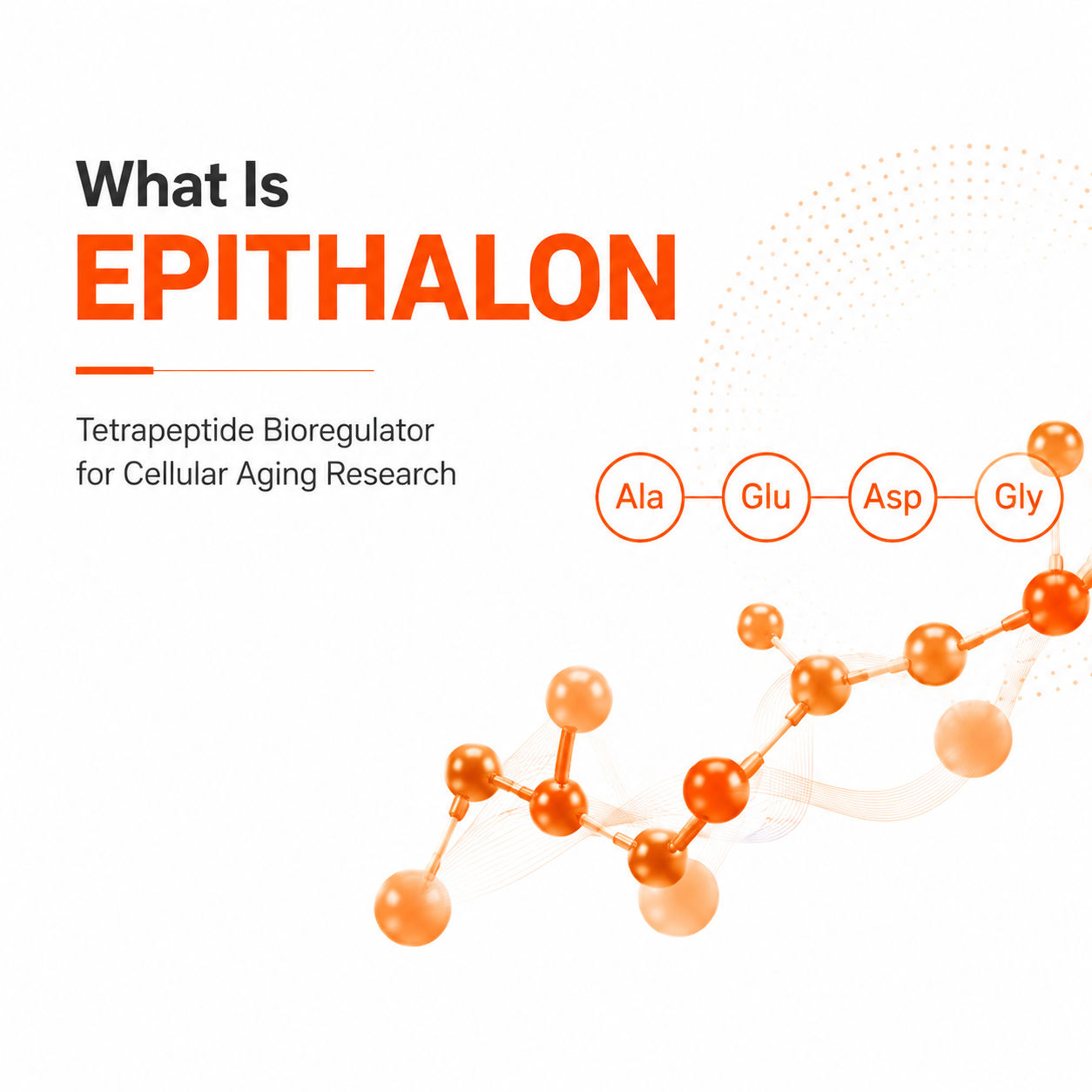
Epithalon, also spelled Epitalon, is a synthetic tetrapeptide (Ala-Glu-Asp-Gly, AEDG).
It is mainly studied in cell cultures and published laboratory animal models for possible effects on telomeres, telomerase, gene activity, and pineal-related markers. These studies do not prove that Epithalon is safe or effective in humans, and they do not support claims that it slows aging, improves sleep, or extends human lifespan.
Epithalon is often discussed together with Epithalamin, but they are not the same material. Epithalamin is a mixture of peptides obtained from bovine pineal tissue.
Epithalon is the defined synthetic sequence Ala-Glu-Asp-Gly, designed from research on the amino-acid content of Epithalamin.[1]
Basic Identity
The sequence of Epithalon is H-Ala-Glu-Asp-Gly-OH, usually shortened to AEDG. The free peptide (non-salt form) has the molecular formula C14H22N4O9, an average molecular weight of 390.35 g/mol, a monoisotopic mass of 390.1387 Da, and CAS number 307297-39-8.
AEDG contains multiple acidic side chains (two carboxyl groups), so “free peptide” or “non-salt form” is chemically more precise than “free base.”[2]
The free peptide and the acetate salt are different chemical forms. The ideal anhydrous 1:1 monoacetate salt has a molecular weight of about 450.40 g/mol (AEDG peptide moiety ~390.35 + acetate ~60.05) and CAS number 307297-40-1.
In this form, the AEDG peptide moiety comprises approximately 86.7% of the ideal anhydrous salt mass, but actual lyophilized material may contain variable water, non-stoichiometric acetate or residual TFA, and other non-peptide components.
The product label and certificate of analysis should clearly state which form was tested, and the batch-specific peptide content should be used for molar calculations rather than the ideal anhydrous composition.[1]
| Item | Free Peptide (non-salt form) | Acetate Salt (ideal anhydrous 1:1 monoacetate) |
|---|---|---|
| Sequence | H-Ala-Glu-Asp-Gly-OH | Same AEDG moiety, present as a monoacetate salt; not N-acetyl-Epitalon |
| Formula | C14H22N4O9 | C14H22N4O9·C2H4O2 |
| Average molecular weight | 390.35 g/mol | 450.40 g/mol (ideal anhydrous 1:1 composition; vary with batch water and counterion content) |
| Monoisotopic mass (free peptide) | 390.1387 Da[2] | Same AEDG peptide moiety; counterion measured separately |
| CAS number | 307297-39-8 | 307297-40-1 |
Telomere and Telomerase Research
Telomeres are protective DNA structures at the ends of chromosomes. Telomerase is an enzyme that can add DNA repeats to telomeres.
Most Epithalon research in this area has measured changes in cultured cells rather than whole organisms.
Khavinson et al. (2003) reported that Epithalon increased expression of the catalytic telomerase subunit, telomerase activity, and telomere length in a culture of telomerase-negative human fetal fibroblasts.[3]
Al-dulaimi et al. (2025) reported changes in telomere length, hTERT expression, telomerase activity, and alternative lengthening of telomeres (ALT) in several normal and cancer cell lines.
A formal correction subsequently replaced incorrect versions of Figures 1, 2, and 3, so readers should use the corrected version of the paper.[4][5]
These are cell-culture results. Gene expression upregulation can show an association or regulatory effect, but it does not by itself prove that AEDG physically binds to the TERT promoter, enters the nucleus, or directly engages a specific DNA sequence.
These cell-culture studies cannot determine whether Epitalon slows organismal aging or changes lifespan.
Other Laboratory Findings
Khavinson et al. (2020) found changes in several neuronal differentiation markers in human gingival mesenchymal stem cells exposed to AEDG.
The same paper used computational molecular modeling to propose possible interactions with histones; modeling results suggest hypotheses but do not constitute direct evidence of physical binding.[6]
These results are limited to the tested cell model and do not prove nerve protection, brain repair, or cognitive improvement.
Results related to melatonin are mixed. Djeridane et al. (2003) tested AEDG at 1, 10, and 100 μM in an in vitro study using pineal glands from young and old rats and found no significant increase in melatonin release at the tested concentrations.[7]
The FDA staff briefing document prepared for the July 23–24, 2026 Pharmacy Compounding Advisory Committee meeting stated that it found no nonclinical study directly measuring sleep behavior or electroencephalographic sleep endpoints after Epitalon exposure.[1]
Melatonin-related measurements should therefore not be described as proof of better sleep.
Laboratory Animal Findings and Safety Limits
Anisimov et al. (2003) studied female Swiss-derived SHR mice and reported that Epitalon did not change mean lifespan, food intake, body weight, or total spontaneous tumor incidence.
The study reported a 13.3% increase in lifespan among the last 10% of surviving mice and a 12.3% increase in maximum lifespan.[8]
These findings apply only to that mouse strain, sex, dose schedule, and study design. They do not support a general lifespan claim or a human longevity claim.
Telomerase is active in approximately 85–90% of primary human tumors, so a laboratory finding that raises telomerase activity should not be treated as proof of safety.[9]
This does not prove that Epithalon causes cancer. It means that long-term safety cannot be assumed from short or limited experiments.
The FDA staff briefing document stated that it did not identify two-year carcinogenicity studies for the free peptide or acetate form. It also found that the available nonclinical studies were too limited in scope and duration to support safety conclusions for human use.
This document is an FDA staff assessment prepared for advisory committee deliberation and does not represent a final regulatory determination.[1]
How to Read the Certificate of Analysis
A certificate of analysis is specific to one batch. It should not be used as proof of human safety or clinical effectiveness.
Chromatographic purity (HPLC area percentage) and peptide content (assay) are different measurements. HPLC area purity should not be used by itself as the mass fraction of active peptide in a lyophilized sample.
Water, acetate or TFA counterions, inorganic salts, residual solvents, and other non-UV-absorbing components can reduce the actual peptide content even when the HPLC main-peak area is high.
For molar concentration calculations, the batch-specific net peptide content or an assay result corrected for water and counterion content should take priority over the HPLC area-normalized purity value.
For general research-grade use, a COA should address:
- Identity: The product name, sequence, chemical form, formula, molecular weight, and CAS number should match. LC-MS should confirm the molecular mass of the AEDG peptide moiety. Counterion identity and amount (e.g., acetate or TFA) generally require a separate quantitative method and should not be inferred solely from the peptide mass spectrum.
- HPLC purity: The COA should state the method, detection wavelength, purity result, and any reported impurity limits.
- Peptide content / assay: A quantitative result that accounts for water, counterions, and other non-peptide material. This is needed for accurate molar calculations.
- Water and counterion: Measured water content (e.g., Karl Fischer) and quantitative counterion result. These directly affect mass-based concentration calculations.
- Related impurities and residual solvents: Peptide-related impurities relevant to the synthesis route should be addressed. Residual solvents require their own validated method (commonly gas chromatography).
For use in cell culture, sterile applications, or animal studies, additional tests should be selected according to the experimental requirements:
- Endotoxin: Testing by LAL, rFC, or another validated method when endotoxin could confound the biological readout or when required for the animal model.
- Bioburden / sterility: Required when the experimental model or formulation route demands it; not inferred from HPLC or MS.
- Aggregation / particulates: AEDG is a short tetrapeptide (~390 Da); aggregation testing is not automatically a routine release test for every batch. It should be selected according to formulation, concentration, and intended assay.
FDA has reported examples in which submitted Epitalon records mixed the name of one chemical form with the formula or molecular weight of another. It also noted gaps in testing for some impurities, residual solvents, microbial load, or endotoxin.
The FDA briefing document discusses quality expectations in the context of bulk drug substances nominated for use in sterile compounding; the scope and stringency of testing for research-use-only materials should be determined by the experimental application rather than automatically matching pharmaceutical compounding standards.[1]
Laboratory Storage and Solution Handling
For laboratory sample preparation only. Do not use this information for human or veterinary administration.
- Lyophilized material: Follow the batch-specific supplier document. Storage at about −20°C or colder, dry, sealed, and protected from light is a common conservative condition for this research material.[1]
- Chemical form: Confirm whether the batch is the free peptide (non-salt form) or an acetate or other salt before calculating molar concentration. The batch-specific net peptide content should be used for molar calculations, not the ideal anhydrous composition.
- Solubility: Do not assume that every form or batch is freely soluble in water. The FDA briefing document noted limited reliable aqueous-solubility data for the free peptide and possible solubility limits at higher concentrations (~3 mg/mL).[1] AEDG contains two acidic side chains, so solubility depends on pH, ionic strength, salt form, target concentration, and buffer composition. Select the solvent according to the peptide form, target concentration, pH, and assay compatibility. When reliable solubility data are unavailable, perform a small-scale solubility and recovery assessment before preparing the full batch.
- Prepared solutions: Do not assign a general refrigerated shelf life without batch-specific stability data. Fresh preparation or validated aliquoting is preferred, and repeated freeze-thaw cycles should be avoided.
Research References
- U.S. Food and Drug Administration. Epitalon-Related Bulk Drug Substances (Epitalon (Free Base) and Epitalon Acetate). FDA Staff Briefing Document for the Pharmacy Compounding Advisory Committee Meeting, July 23–24, 2026. https://www.fda.gov/media/193345/download
- National Center for Biotechnology Information. PubChem Compound Summary for CID 219042, Epitalon. https://pubchem.ncbi.nlm.nih.gov/compound/Epitalon
- Khavinson VKh, Bondarev IE, Butyugov AA. Epithalon peptide induces telomerase activity and telomere elongation in human somatic cells. Bulletin of Experimental Biology and Medicine. 2003;135(6):590-592. doi:10.1023/A:1025493705728. https://pubmed.ncbi.nlm.nih.gov/12937682/
- Al-dulaimi S, Thomas R, Matta S, Roberts T. Epitalon increases telomere length in human cell lines through telomerase upregulation or ALT activity. Biogerontology. 2025;26:178. doi:10.1007/s10522-025-10315-x. https://link.springer.com/article/10.1007/s10522-025-10315-x
- Al-dulaimi S, Thomas R, Matta S, Roberts T. Correction: Epitalon increases telomere length in human cell lines through telomerase upregulation or ALT activity. Biogerontology. 2026;27:1. doi:10.1007/s10522-025-10326-8. https://link.springer.com/article/10.1007/s10522-025-10326-8
- Khavinson V, Diomede F, Mironova E, Linkova N, Trofimova S, Trubiani O, Sinjari B. AEDG Peptide (Epitalon) Stimulates Gene Expression and Protein Synthesis during Neurogenesis: Possible Epigenetic Mechanism. Molecules. 2020;25(3):609. doi:10.3390/molecules25030609. https://pubmed.ncbi.nlm.nih.gov/32019204/
- Djeridane Y, Khavinson VKh, Anisimov VN, Touitou Y. Effect of a synthetic pineal tetrapeptide (Ala-Glu-Asp-Gly) on melatonin secretion by the pineal gland of young and old rats. Journal of Endocrinological Investigation. 2003;26(3):211-215. doi:10.1007/BF03345159. https://pubmed.ncbi.nlm.nih.gov/12809170/
- Anisimov VN, Khavinson VKh, Popovich IG, Zabezhinski MA, Alimova IN, Rosenfeld SV, Zavarzina NY, Semenchenko AV, Yashin AI. Effect of Epitalon on biomarkers of aging, life span and spontaneous tumor incidence in female Swiss-derived SHR mice. Biogerontology. 2003;4(4):193-202. doi:10.1023/A:1025114230714. https://link.springer.com/article/10.1023/A%3A1025114230714
- Buseman CM, Wright WE, Shay JW. Is telomerase a viable target in cancer? Mutation Research. 2012;730(1-2):90-97. doi:10.1016/j.mrfmmm.2011.07.006. https://pmc.ncbi.nlm.nih.gov/articles/PMC3375693/
Research Use Only Disclaimer
Research Use Only: All NEXALUME LABS products are intended and labeled solely for laboratory research use.
They are not intended, manufactured, tested, or released for human or veterinary administration.
This article provides general scientific information regarding standard laboratory in vitro and in vivo research contexts only, and does not constitute a validated experimental protocol, medical guidance, clinical guidance, veterinary guidance, or treatment advice.