Research Use Only Notice: This article discusses Semax only as a laboratory research peptide. The information below is limited to in vitro work and qualified laboratory animal models.
The material described is intended and labeled solely for laboratory research use. It is not manufactured, tested, or released for human administration, veterinary administration, diagnosis, treatment, cosmetic use, or personal use.
Any storage or sample-preparation details are laboratory information only and must not be used as dosing or administration instructions.
Semax is a synthetic all-L heptapeptide H-Met-Glu-His-Phe-Pro-Gly-Pro-OH. Its first four residues match the ACTH(4-7) fragment, and its last three residues are Pro-Gly-Pro; the complete heptapeptide is therefore described as ACTH(4-7)-PGP.
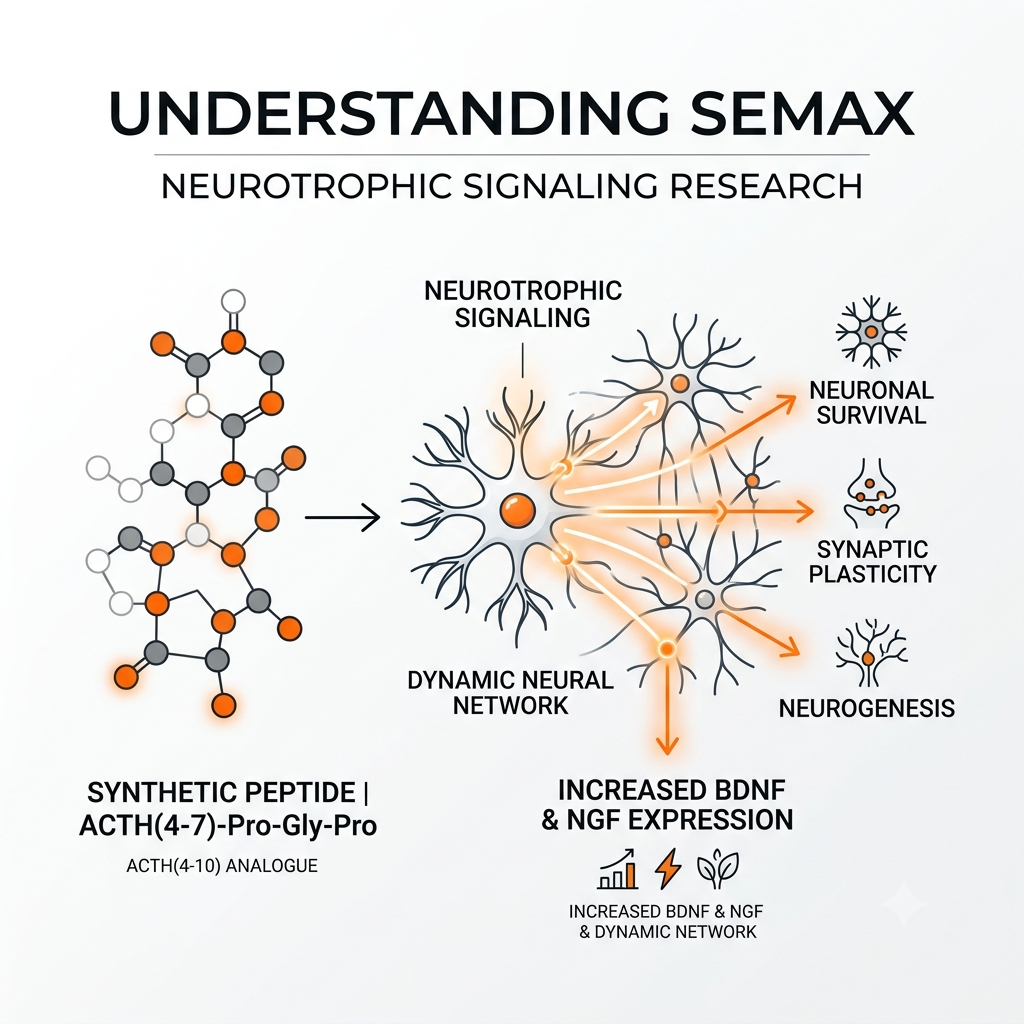
In historical length-based nomenclature it is often referred to as an ACTH(4-10) analogue, although the C-terminal tripeptide is not the native ACTH(8-10) sequence. Published findings about Semax normally refer to the complete seven-amino-acid peptide, not to ACTH(4-7) alone.[1]
Most of the laboratory evidence discussed below comes from rat brain tissue, membrane preparations, cultured rat astrocytes, and in vivo rat models. These results can help researchers choose laboratory questions, but they do not show that the material is safe or effective for people or animals.
Molecular Identity
| Parameter | Semax Free Peptide (neutral parent) |
|---|---|
| Amino acid sequence | H-Met-Glu-His-Phe-Pro-Gly-Pro-OH |
| One-letter sequence | MEHFPGP |
| Residue count | 7 (all-L stereochemistry) |
| N-terminus | Free amine |
| C-terminus | Free carboxylic acid |
| CAS number (free peptide) | 80714-61-0 |
| Molecular formula (free peptide) | C37H51N9O10S |
| Average molecular weight (free peptide) | 813.9 g/mol |
| Monoisotopic exact mass (free peptide) | 813.34796 Da[1] |
| PubChem CID | 9811102 |
The sequence, formula, average molecular weight, monoisotopic exact mass, CAS number, and PubChem CID above match the NCBI PubChem record for Semax and refer to the neutral free peptide.[1] The molecular formula and weight listed above do not include TFA, acetate, water, or residual solvents.
A batch COA should separately state the salt form and counterion content (e.g., TFA or acetate) because these change the sample’s total composition, the mass basis for molar calculations, and the net peptide content.
Semax contains methionine at its N-terminus. Methionine can oxidize, so unnecessary exposure to air, light, heat, and repeated handling should be limited.
A fixed water-solubility value should not be used unless it is supported by data for the actual batch, solvent, pH, and concentration.
Binding and Breakdown in Rat Laboratory Studies
Dolotov et al. (2004) studied [G-3H]Semax binding to rat forebrain basal nuclei plasma membranes. Binding was time-dependent, specific, reversible, and calcium-dependent, with a dissociation constant (Kd) of 2.4 ± 1.0 nM and a Bmax of 33.5 ± 7.9 fmol/mg protein.
The study did not identify the binding site as MC4R, MC5R, or another named receptor. In the same membrane incubation system, Semax degradation followed a sequential dipeptidylaminopeptidase pathway (Semax → HFPGP → PGP), with a degradation half-life longer than 1 hour under those specific in-vitro conditions.[2]
Shevchenko et al. (2006) studied the kinetics of C-terminally radiolabeled Semax after intranasal administration in rats. Both intact Semax and breakdown products were detected shortly after experimental exposure, with rapid enzymatic degradation and Pro-Gly-Pro becoming a major detected fragment.
The apparently different degradation rates between these two studies reflect different matrices and sampling conditions; the in vivo study specifically detected C-terminally radiolabeled species.[3] These findings collectively show that Semax is not fully protected from degradation and that the amount of intact peptide depends on the sample type, labeling position, and collection time.
BDNF and TrkB Findings
Dolotov et al. (2006) found that intranasal Semax (50 and 250 μg/kg) increased BDNF protein levels in the rat basal forebrain at 3 hours post-administration, while no increase was observed in the cerebellum. The binding experiments and BDNF measurements in this paper were conducted in separate experimental arms—binding in isolated membrane preparations and BDNF in tissue from in-vivo administration.[4]
A separate study by the same group reported that a single Semax exposure produced changes in hippocampal BDNF protein (up to approximately 1.4-fold), TrkB tyrosine phosphorylation (approximately 1.6-fold), Bdnf mRNA transcript levels (up to approximately 3-fold), and TrkB mRNA (approximately 2-fold).[5] These hippocampal findings and the basal forebrain findings came from separate experiments and should not be presented as one combined time course.
Shadrina et al. (2010) measured NGF and BDNF gene expression by real-time PCR in the hippocampus, frontal cortex, and retina of male Wistar rats at 20 min, 40 min, 90 min, 3 h, 8 h, and 24 h after Semax administration. Multidirectional activation was observed: expression of both neurotrophin genes was decreased in hippocampus and retina at 20 min after administration and increased in the frontal cortex.
NGF expression remained practically constant in the retina at the initial stage, while BDNF expression was significantly increased at 90 min. The direction of change was not the same in every tissue or at every time point.[6]
For this reason, the broad statement “Semax increases BDNF and NGF” is incomplete unless the tissue, time point, model, and test method are also stated.
Other Findings in Rat Brain Models
Medvedeva et al. (2014) performed gene-expression analysis in a rat model of focal brain ischemia and found that Semax affected the expression of genes linked to immune and vascular processes. The researchers noted that the full molecular mechanism was still unclear.[7]
Sudarkina et al. (2021) studied brain protein expression changes in a rat model of cerebral ischemia-reperfusion. After Semax exposure, tissue-specific changes in phosphorylated JNK (pJNK), phosphorylated CREB (pCREB), MMP-9, and c-Fos were observed at 24 hours, with the changes varying by brain region rather than occurring uniformly across all tissues.
These results describe changes in one animal model. They do not prove that Semax works through one single pathway, and they should not be turned into human or veterinary benefit claims.[8]
What Is Still Unknown
- The direct molecular receptor for Semax has not been clearly identified in the cited studies.
- The cited studies do not prove a direct MC4R- or MC5R-driven signaling pathway.
- Changes in BDNF, TrkB, genes, or proteins show an association under specific test conditions; they do not by themselves prove the full cause-and-effect pathway.
- Results from rat tissue or rat models cannot be used to claim human or veterinary safety, effectiveness, or dosing.
Laboratory Handling and Storage
Laboratory-only handling note: The following points are for trained laboratory staff preparing research samples. They are not administration instructions.
- Check the batch documents. Confirm the sequence, lot number, counterion, purity method, identity method, storage condition, and retest or expiry information on the batch COA.
- Store the lyophilized material correctly. Follow the lot-specific storage statement. When no validated batch instruction is available, −20°C with protection from light and moisture is a conservative laboratory default, not a guaranteed shelf-life claim. Allow a cold sealed vial to reach room temperature before opening to reduce moisture condensation.
- Choose the solvent from the experiment. Do not assume that one solvent, pH, or concentration works for every assay. Run a small solubility test when batch-specific data are not available.
- Do not assign a universal refrigerated solution lifetime. Solution stability can change with pH, concentration, buffer, oxygen, light, temperature, and container type. Storage periods should be supported by stability data. ICH Q1A(R2) is cited here only as a general stability framework and does not by itself set regulatory specifications for this research-use-only material.[9]
- Limit freeze-thaw cycles. When frozen solution storage has been validated, use small laboratory aliquots to reduce repeated thawing.
- Validate filtration. A 0.22 μm low-protein-binding filter may be used in a suitable cell-culture workflow, but filtration alone does not prove sterility, low endotoxin, or absence of mycoplasma. Check peptide recovery because some material may bind to the filter.
How to Read a Semax Research COA
| COA Item | What It Shows | Main Limit |
|---|---|---|
| Mass spectrometry | Whether the detected mass matches the expected peptide ion | A matching mass does not by itself prove purity, exact sequence, peptide content, or sterility |
| RP-HPLC purity | The relative main-peak area under the stated HPLC method | HPLC area percentage is not the same as absolute peptide content |
| Peptide content or assay | The measured amount of peptide in the material when a suitable quantitative method is used | It does not identify every impurity |
| Water | The measured moisture level, often by Karl Fischer testing | It does not measure residual organic solvents |
| Residual solvents | The listed solvents measured by the stated method | Only solvents covered by the method and specification are addressed |
| Counterion | Whether the material contains TFA, acetate, or another stated counterion, and at what level | Ignoring the counterion can produce an incorrect mass or concentration calculation |
| Bioburden / microbial limits | Total aerobic microbial count or other microbiological test, when performed | Bioburden testing does not demonstrate sterility or specific endotoxin levels |
| Bacterial endotoxin | The measured endotoxin level by LAL, rFC, or another stated method for the tested batch | An endotoxin result applies only to the method, reporting unit, and sample concentration tested |
| Sterility | Whether the batch passed a validated sterility test, when performed and claimed | Sterility testing does not by itself prove the material is free of endotoxin, mycoplasma, or viral contamination |
HPLC and mass spectrometry answer different questions, so they should not be treated as interchangeable. The analytical method should be suitable for its purpose and should be checked for factors such as accuracy, precision, specificity, and range.
ICH Q2(R2) is cited here only as a general analytical validation framework and does not establish regulatory specifications for this research-use-only material.[10] A useful specification should list the test, method, and acceptance limit rather than relying on one headline purity number; ICH Q6A is cited here as a general specification framework.[11]
Residual-solvent testing should identify which solvents are included in the method and how the limits were set; ICH Q3C(R9) is cited here as a general residual-solvent classification framework.[12]
There is no single HPLC purity percentage that makes every Semax batch suitable for every research project. The required purity and impurity limits should match the experiment.
A COA is a batch quality-control record; it does not show human safety, human effectiveness, veterinary suitability, or approval for non-research use.
Research References
- NCBI PubChem. ACTH (4-7), Pro-Gly-Pro- (Semax), CID 9811102. https://pubchem.ncbi.nlm.nih.gov/compound/Semax
- Dolotov OV, Zolotarev YA, Dorokhova EM, Andreeva LA, Alfeeva LY, Grivennikov IA, Myasoedov NF. The binding of Semax, ACTH 4-10 heptapeptide, to plasma membranes of the rat forebrain basal nuclei and its biodegradation. Russian Journal of Bioorganic Chemistry. 2004;30(3):241-246. doi:10.1023/b:rubi.0000030127.46845.f0. PMID: 15344653. https://pubmed.ncbi.nlm.nih.gov/15344653/
- Shevchenko KV, Nagaev IY, Andreeva LA, Shevchenko VP, Myasoedov NF. Kinetics of Semax penetration into the brain and blood of rats after its intranasal administration. Russian Journal of Bioorganic Chemistry. 2006;32(1):57-62. PMID: 16523722. https://pubmed.ncbi.nlm.nih.gov/16523722/
- Dolotov OV, Karpenko EA, Seredenina TS, Inozemtseva LS, Levitskaya NG, Zolotarev YA, Kamensky AA, Grivennikov IA, Engele J, Myasoedov NF. Semax, an analogue of adrenocorticotropin (4-10), binds specifically and increases levels of brain-derived neurotrophic factor protein in rat basal forebrain. Journal of Neurochemistry. 2006;97(Suppl 1):82-86. doi:10.1111/j.1471-4159.2006.03658.x. PMID: 16635254. https://pubmed.ncbi.nlm.nih.gov/16635254/
- Dolotov OV, Karpenko EA, Seredenina TS, Inozemtseva LS, Levitskaya NG, Zolotarev YA, Kamensky AA, Grivennikov IA, Engele J, Myasoedov NF. Semax, an analog of ACTH(4-10) with cognitive effects, regulates BDNF and trkB expression in the rat hippocampus. Brain Research. 2006;1117(1):54-60. PMID: 16996037. https://pubmed.ncbi.nlm.nih.gov/16996037/
- Shadrina M, Kolomin T, Agapova T, Agniullin Y, Shram S, Slominsky P, Lymborska S, Myasoedov N. Comparison of the temporary dynamics of NGF and BDNF gene expression in rat hippocampus, frontal cortex, and retina under Semax action. Journal of Molecular Neuroscience. 2010;41(1):30-35. doi:10.1007/s12031-009-9270-z. PMID: 19662538. https://pubmed.ncbi.nlm.nih.gov/19662538/
- Medvedeva EV, Dmitrieva VG, Povarova OV, Limborska SA, Skvortsova VI, Myasoedov NF, Dergunova LV. The peptide Semax affects the expression of genes related to the immune and vascular systems in a rat model of focal cerebral ischemia. Genome Biology and Evolution. 2014;6(4):792-803. PMID: 24661604; PMCID: PMC3987924. https://pmc.ncbi.nlm.nih.gov/articles/PMC3987924/
- Sudarkina OY, Filippenkov IB, Stavchansky VV, Denisova AE, Limborska SA, Dergunova LV. Brain protein expression profile after Semax administration in a rat model of cerebral ischemia-reperfusion. Biomedicines. 2021;9(7):784. PMID: 34201112; PMCID: PMC8226508. https://pmc.ncbi.nlm.nih.gov/articles/PMC8226508/
- U.S. Food and Drug Administration. Q1A(R2): Stability Testing of New Drug Substances and Products. FDA Q1A(R2)
- U.S. Food and Drug Administration. Q2(R2): Validation of Analytical Procedures. FDA Q2(R2)
- U.S. Food and Drug Administration. Q6A: Specifications, Test Procedures, and Acceptance Criteria. FDA Q6A
- U.S. Food and Drug Administration. Q3C(R9): Impurities—Residual Solvents. FDA Q3C(R9)
Research Use Only Disclaimer
Research Use Only: All NEXALUME LABS products are intended and labeled solely for laboratory research use. They are not intended, manufactured, tested, or released for human or veterinary administration.
This article provides general scientific information regarding standard laboratory in vitro and in vivo research contexts only, and does not constitute a validated experimental protocol, medical guidance, clinical guidance, veterinary guidance, or treatment advice.